
How to Plant a Tree That Will Not Interfere with Your Power Lines
A well-placed tree can cool a home, reduce wind exposure, support wildlife, and improve curb appeal. The same tree can become a serious maintenance problem if its mature branches grow into overhead utility lines. Planning for the tree’s full size, rather than its appearance at the nursery, is the key to avoiding future conflicts.
Power lines are not always easy to see from ground level. They may cross a side yard, run behind a fence, or connect to the house from an angle that is easy to overlook. Before buying a sapling, inspect the entire planting area and identify nearby poles, service wires, transformers, underground utility markers, driveways, and property boundaries.
Homeowners can find broader seasonal upkeep guidance through the home maintenance resources, while this project requires special attention to electrical safety and local planting conditions. A few minutes of planning can prevent aggressive pruning, outages, damaged equipment, and the removal of a mature tree.
Start with a complete site inspection
Walk the property from several viewpoints and trace every visible overhead wire. Pay particular attention to the service drop, which is the line running from a utility pole to the house. A tree planted several feet away from the trunk can still create trouble if its upper canopy eventually spreads beneath or around that wire.
Measure the planting location from poles, buildings, fences, sidewalks, and septic components. Also check for underground utilities before digging. Contact the appropriate utility-locating service in your area and wait until underground lines have been marked. Avoid assuming that a shallow-looking wire or cable is harmless; communications and electrical lines can share the same general corridor.
Match the tree to the available space
Read the nursery tag for mature height and mature canopy width, not just the container size. A tree labeled as small may still reach 20 or 30 feet, while a fast-growing shade tree may eventually extend far beyond the planting bed. Allow room for the crown to spread without reaching conductors, roofs, gutters, or neighboring structures.
The safest location beneath or near utility corridors is usually reserved for trees that remain genuinely small at maturity. Ornamental species, dwarf cultivars, and naturally narrow trees may work where a large oak, pine, or sweetgum would not. Confirm the mature dimensions from a reputable extension service or local arborist because cultivar names and nursery descriptions can be inconsistent.
Select species with predictable growth
Choose trees with a mature height that stays comfortably below the lowest power line. A tree that grows 15 feet tall at maturity may be suitable near a line positioned high above the yard, but the required clearance depends on the wire type, location, utility rules, and the tree’s branching pattern. Do not treat a small gap as a reliable safety margin.
Avoid species known for weak branch attachments, brittle wood, invasive roots, or rapid growth directly under utilities. Stronger, slower-growing trees often require less corrective pruning. In warm regions, suitable options may include certain dwarf crape myrtles, Japanese maples, redbuds, or other compact ornamental trees, but local climate, soil, disease pressure, and water availability should guide the final choice.
Compare mature size and placement
The table below provides a planning framework rather than a universal clearance rule. Always verify the mature dimensions of the exact cultivar and follow instructions from the local electric utility.
| Planting situation | Better tree profile | Main concern | Planning approach |
|---|---|---|---|
| Directly below a service line | Compact ornamental tree with a low mature height | Branches may grow around the wire | Select a small species and maintain a broad vertical buffer |
| Beside a utility corridor | Narrow or columnar crown | Side branches can reach conductors | Place the trunk beyond the expected mature canopy |
| Near a power pole | Small, upright tree with non-invasive roots | Equipment access and climbing clearance | Keep the area open for utility workers |
| Near a house service connection | Low-growing, slow-growing tree | Storm damage could affect the roof or wiring | Favor a distant planting site over tight spacing |
| Open yard away from lines | Medium or large shade tree | Roots, canopy, and storm movement | Confirm there is room for the full mature spread |
Use spacing rather than frequent trimming
A common mistake is planting a tree in the preferred visual location and planning to control it with annual pruning. Topping, heavy reduction, and repeated cutting near power lines can weaken the tree, encourage vigorous shoots, and create a cycle of expensive maintenance. Pruning should support healthy structure, not compensate for an unsuitable location.
Estimate the tree’s mature radius by dividing its mature width in half, then add extra room for storm movement and irregular growth. The trunk should be positioned far enough from the line that the mature crown will not touch it. Because clearance standards vary, ask the utility company or a qualified arborist for site-specific guidance before planting near conductors.
Plant for healthy roots and stable growth
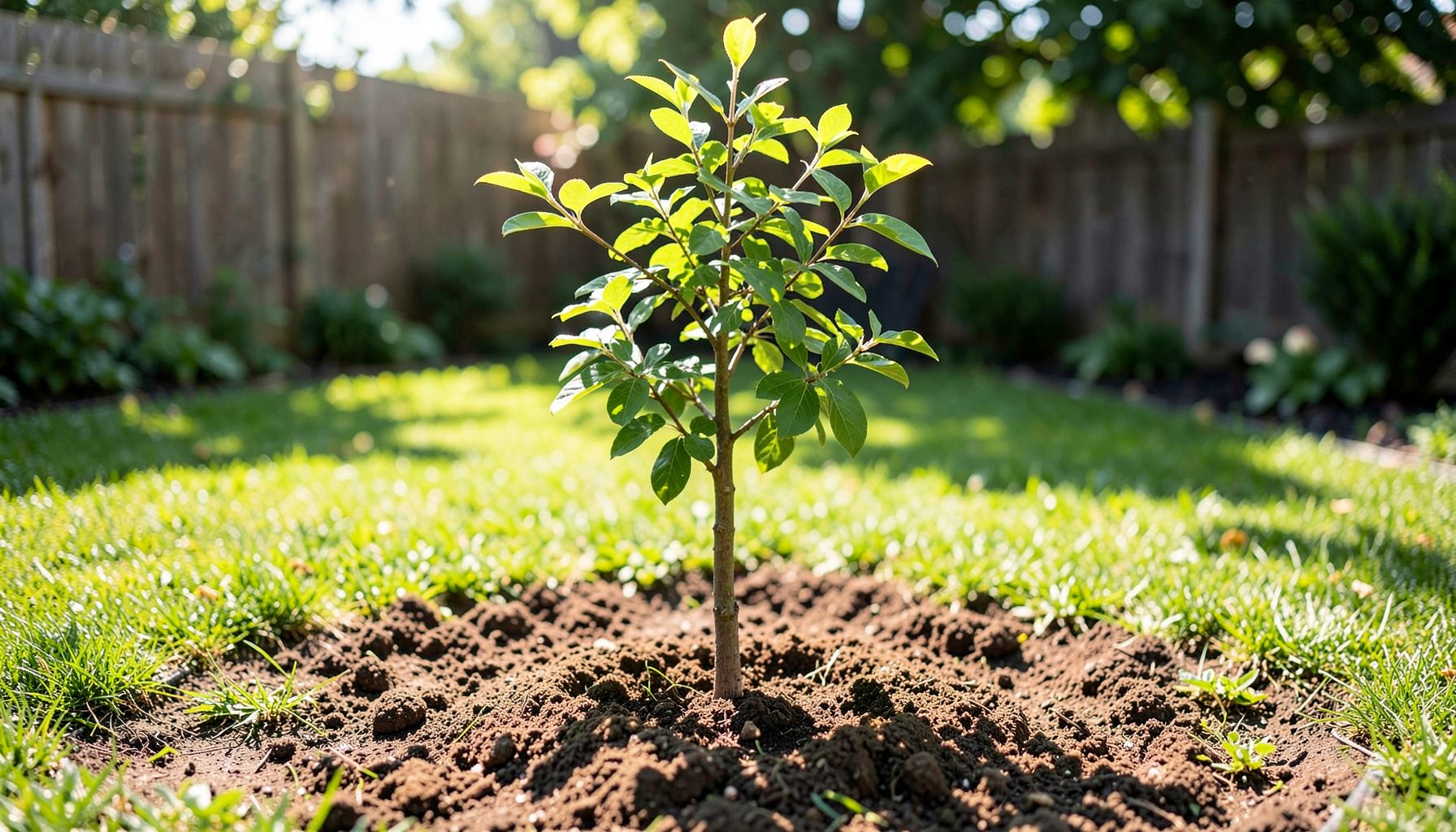
A tree stressed by poor planting is more likely to develop weak branches, lean, or suffer from pests and disease. Dig a hole no deeper than the root ball and two to three times wider. The trunk flare should remain visible at soil level; burying it can cause decay, girdling roots, and long-term instability.
Remove circling roots when appropriate, loosen compacted soil around the hole, and water deeply after planting. Apply a shallow layer of mulch over the root zone, keeping it several inches away from the trunk. Do not pile mulch against the bark, and avoid fertilizing at planting unless a soil test or local expert recommends it.
Account for storms and future maintenance
A tree that appears safely placed on a calm day may swing into a line during high winds. Consider the direction of prevailing storms, the slope of the yard, soil drainage, and whether nearby trees could fall onto the new planting or wires. Trees near utilities deserve more conservative spacing than trees in a fully open area.
Inspect the tree at least once each season during its early years. Look for a leaning trunk, dead branches, rubbing limbs, cracks, suckers, or growth directed toward electrical conductors. Never prune a branch that is touching or close to a power line. Utility-line trimming should be handled by the electric company or a qualified professional equipped for that work.
Protect nearby wood and structures
Utility clearance is only one part of a successful planting plan. Keep vigorous roots away from foundations, drains, septic systems, paved surfaces, and underground pipes. Place deciduous trees where falling leaves will not constantly block gutters, and avoid planting large trees where branches could scrape siding or windows.
Moisture and poor ventilation can also damage nearby wooden elements. If a tree will shade a wall or window heavily, maintain airflow and check for peeling paint, persistent dampness, or soft wood. The guidance on wood window rot offers useful background for recognizing deterioration before it spreads.
A practical planting checklist
Use these steps before placing the tree in the ground:
- Trace overhead lines and identify the service connection to the house.
- Request underground utility locating before digging.
- Confirm the tree’s mature height, width, root behavior, and growth rate.
- Measure outward from the planting spot to estimate the full mature canopy.
- Keep utility access areas, poles, transformers, and equipment clear.
- Water deeply during establishment and inspect for unsafe growth each season.
If a tree is already too close to a line, do not attempt to solve the problem by cutting large limbs yourself. Utility providers may have clearance requirements or preferred procedures, and a certified arborist can assess structure, pruning options, and removal needs without creating additional hazards. You can also review the site’s property information when organizing broader home maintenance records and responsibilities.
Plant the smallest suitable tree in the most spacious safe location, then give it room to mature. Before purchasing, mark the proposed spot, sketch the expected canopy, and contact your utility provider or an arborist for advice on clearances. That simple preparation helps create a healthier landscape with fewer power-line conflicts for years to come.