
How to Plant a Shade Tree for an Australian Backyard
A tree is the cheapest piece of shade hardware you can put around a house. Choose the right species and position, and a plane tree, jacaranda or native canopy can pull the temperature down over the patio, soften glare off west-facing windows and give the kids somewhere to sit after school. Choose poorly and you inherit a thirsty sapling, a lifted driveway or a tree that has to come out within five years.
Most of the hard work happens before a shovel enters the soil. Site choice, species and planting technique decide whether the tree thrives or struggles, and those decisions matter more in Australia than in many other countries, where summer sun is fierce, winters can be dry, and councils keep tight rules about what you may cut or plant. The process below works from Melbourne's fickle spring to Perth's sand and Sydney's clay, and it takes no more than a weekend and a bag of mulch. If you are working through other jobs around the house as well, the home upkeep guides here cover everything from appliance faults to water damage.
Choose a tree that can handle your weather
Start with the weather, not the wish list. Melbourne and Hobart can deliver frost in August and 40-degree days in January, while Brisbane stays humid and largely frost-free but bakes through summer. Canberra is cold and bright, Perth is hot and dry with sand that drains in minutes, and coastal suburbs deal with salt-laden onshore winds. A species that thrives in one of those climates may sulk in another.
Deciduous species earn their popularity because they leaf out in spring and drop their leaves in autumn, giving the house winter sun when the days are short. London plane, tulip tree, trident maple and sweet gum all tolerate a broad range of Australian conditions, though they can shed leaves early after a late frost. Evergreens such as lilly pilly, brush cherry and Queensland white cedar shade year-round and suit Brisbane or the subtropics, but they carry a heavier water load and can suffer through a dry summer. Natives are worth considering for wildlife value, although some grow slowly, and you should check whether a species is desirable in your council area before committing.
Then check the mature size and the form of the stock. A "small" ornamental can finish up eight metres tall, with roots that lift pavers and push into pipes. Ask the nursery for the expected height and spread, and for a grafted or advanced tree if you want immediate canopy. Container-grown stock is cheaper and easier to reposition, while an advanced tree costs several hundred dollars and arrives with a metre of crown already developed. Buying from a local nursery reduces transplant shock and sidesteps the biosecurity paperwork involved in importing plant material.
Find the right spot and check the rules
Spend a full day watching where the sun lands. Note the summer arc and where the shade falls in winter. A position that bakes in January suits a tree that will be bare in July, while a patio that needs summer shade wants a deciduous species planted to the north-west. Watch for frost pooling in a low corner, for reflected heat off a brick wall, and for wind funneling between two houses.
Legal and practical constraints come next. Many Australian councils maintain significant tree registers and issue tree preservation orders, and some require a permit before you remove, heavily prune or plant on a front boundary line. State biodiversity and planning legislation can protect existing habitat trees, so ring the council before touching anything near the street or a neighbouring tree. Powerlines set another hard limit: Australian electricity safety rules require minimum clearances, generally around ten metres, and a tree that reaches the network is a fault you cannot resolve yourself. Utility locators and a check of the easement plan on your title can save an afternoon of digging.
Leave room for growth. Keep the canopy clear of roof tiles, gutters, air-conditioning units and the neighbour's fence, and keep a healthy distance from any septic tank or soakage pit. Roots head towards moisture, so a tree beside a rainwater tank or a frequently irrigated lawn will spread further than the label suggests.
Dig the hole and set the root ball right
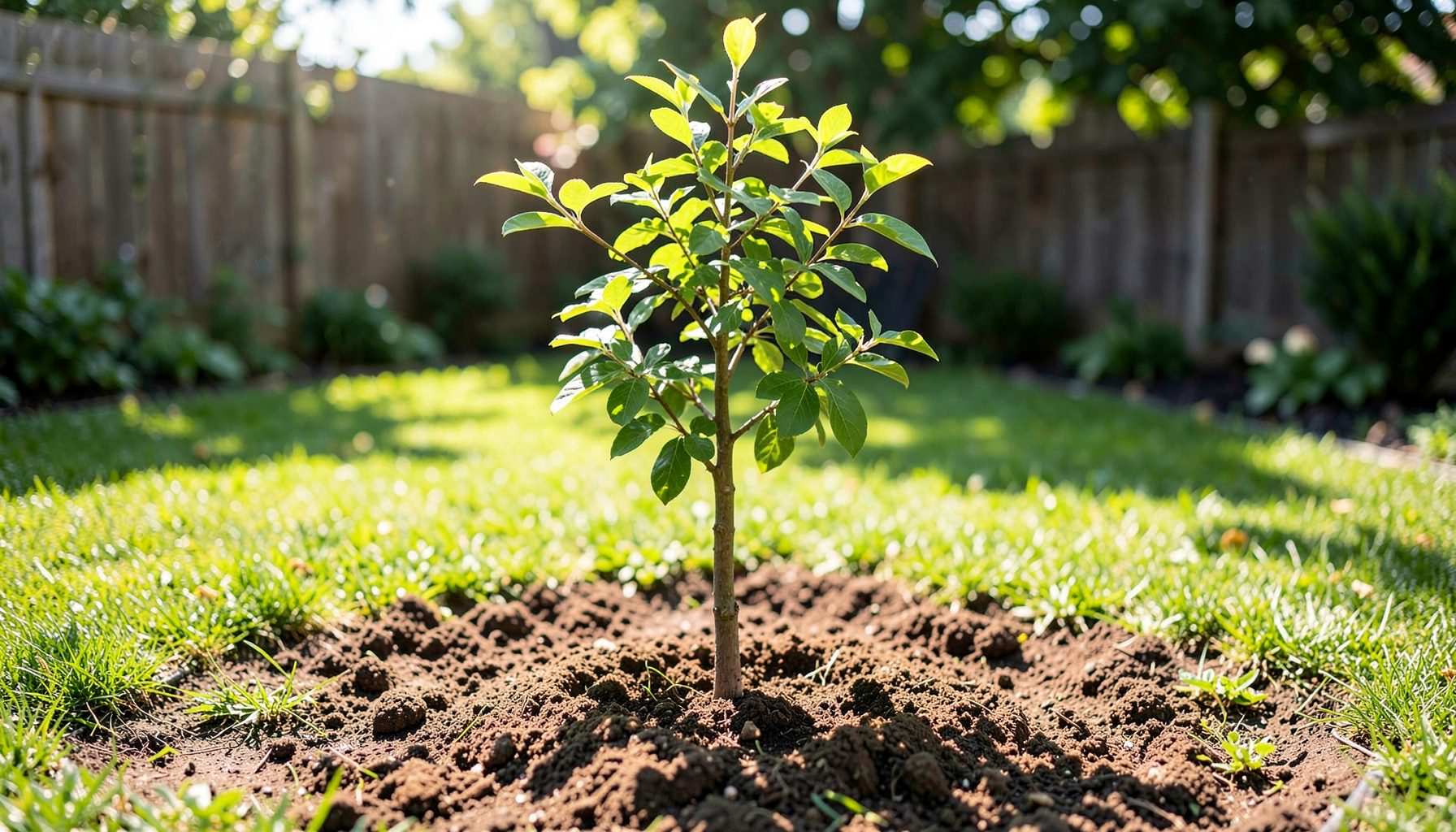
The planting hole is where most amateur plantings go wrong. Dig it wide and shallow, roughly twice the width of the pot and only slightly deeper than the root ball. A narrow hole forces roots to circle and spiral, and a hole filled with rich potting mix becomes a bathtub that holds water around the roots and drowns them.
Test the soil before you dig. Scoop out a spade's depth and squeeze it in your hand. If it breaks into a fine powder when wet, it will set like concrete in summer. Heavy clay around Sydney or Newcastle's inland suburbs can be improved with gypsum and compost worked through the wider bed, not just the hole. Coastal and western soils are often alkaline, and some species will not establish well without the right soil biology.
Plant bare-root or container stock at the same depth it held in the nursery. Tease circling roots outward, trim torn ones with clean secateurs, and keep the graft union, the swollen joint where trunk meets root stock, above soil level. Never bury the trunk and never mound soil up against it.
Plant it, mulch it and water it in
Mark the tree's position before the hole is dug, then slide the root ball in and check the depth against the original soil line on the trunk. Backfill with the excavated soil broken up by hand, rather than a pocket of compost that creates a rich layer surrounded by poor ground. Firm it as you go, then water slowly and deeply to settle the soil and close air pockets. A taller tree needs two flexible ties and a stake set at the edge of the root ball, with the ties checked every few months so they do not bite into the bark.
Mulch earns its keep. A 75 to 100 millimetre layer of coarse bark, woodchip or leaf mould keeps the soil damp, suppresses weeds and buffers root-zone temperatures through a January heatwave. Keep it five to ten centimetres clear of the trunk, because mulch piled against the bark encourages rot and gives rats a runway. Hold grass and weeds away for the first couple of summers, since lawn competes directly for water and nutrients and young tree roots rarely win that contest.
Care for the tree through its first three years
New trees need water far more than they need food. Soak deeply once a week through the first year, twice a week during a heatwave, and always check the local rules before turning on a sprinkler. Sydney Water households, for example, are limited to set watering days and sprinkler hours, and Melbourne Water applies similar restrictions. A thorough watering early in the morning is worth more than a daily sprinkle, because shallow watering keeps roots near the surface where the soil dries fastest. Mulch and a drip line under the canopy make this routine easier to keep up.
Feed only when a soil test shows a real deficiency. Many Australian garden soils are low in phosphorus, yet routine fertilising pushes soft, sappy growth that attracts pests and drinks more water than the tree needs. Skip the lime unless a test calls for it.
Prune lightly in the early years to build a sound framework, and remove the stake once the trunk has thickened and the roots grip in a wind. Watch for scale, aphids, leaf miners and fungal leaf spots, and inspect the tree after storms for snapped limbs. For pruning, pests and general tree health, browse the tree care guides before reaching for a chainsaw. Keep kitchen waste out of the root zone as well, since grease and scraps left in the grass can smother the site and mean another afternoon spent on garbage disposal jams.
The difference between a tree that lives for decades and one that struggles comes down to two choices made in the nursery aisle and at the back fence: a species that suits your climate and your watering habits, and a position where it can reach maturity without fighting the roof, the pipes or a protected tree. Everything afterwards, including mulch, deep watering and an annual prune, is upkeep rather than rescue.
Make the next step concrete: this weekend, dig a test hole where you think the tree belongs, pour a bucket of water into it and leave it overnight to see how fast it drains and how far the roots will have to travel.