
How to plant a sapling in clay soil
Clay soil can support a healthy tree, but it needs careful preparation. Its fine particles hold nutrients and moisture well, yet they can become sticky when wet and hard as concrete when dry. Poorly managed clay may restrict oxygen around new roots, causing a sapling to struggle even when it receives regular watering.
The best approach is to work with the soil rather than replacing it entirely. A young tree needs a broad, stable root zone, reliable drainage and enough air between soil particles. Planting into a small pocket of improved soil can create a “pot in the ground” effect, leaving roots trapped or waterlogged.
Australian conditions make timing especially important. In much of southern Australia, planting in autumn gives roots time to settle before the hot, dry summer. In tropical and subtropical areas, the wet season may be suitable, provided the site drains freely and the young tree will not sit in saturated ground.
Choose a species suited to your local climate, mature size and soil. A reputable Australian nursery can recommend native or exotic trees for heavy ground, while your local council can advise about street planting, underground services and protected trees. Before digging, check these practical details rather than treating the sapling as a simple garden ornament.
Check the soil and planting site
Start by observing the area after rain. If puddles remain for a day or more, the problem may be drainage rather than a lack of water. Dig a test hole about 400 millimetres deep and fill it with water. Once it drains, fill it again and watch how quickly the level falls. Very slow drainage calls for a different location, a raised planting mound or professional advice.
Avoid planting at the lowest point of the yard, beside a downpipe outlet or where roof runoff concentrates. Clay in western Sydney, parts of Melbourne and many inland Australian gardens may also shrink and swell with seasonal moisture changes. Keep the tree away from foundations, retaining walls and paving according to its expected mature spread.
Before digging, use the home maintenance advice on the site as a reminder to check nearby pipes, cables and other household risks. Contact your utility provider before excavating, and check council requirements if the tree will be close to a footpath or verge.
Choose a suitable sapling
A small, healthy sapling often establishes faster than a large tree because its root system has less top growth to support. Look for firm stems, evenly coloured leaves and roots that are light coloured and plentiful. Avoid plants with a circling mass of roots, a damaged trunk, wilted foliage or roots emerging heavily from the drainage holes.
Match the tree to the soil, rainfall and temperature of your region. Some Australian natives tolerate heavy clay once established, but “native” does not automatically mean suitable for every garden. A plant from a dry woodland may perform poorly in a wet coastal site, while a species suited to Brisbane conditions may not cope with frost in Canberra or Ballarat.
Consider the mature canopy before buying. Keep large trees away from overhead wires, septic systems and buildings, and allow clearance for vehicles on narrow suburban blocks. Ask the nursery about the root behaviour of the species, expected growth rate and whether it needs a stake during its first year.
Prepare clay without overworking it
Work the ground when it is moist enough to crumble but not wet enough to smear. Squeeze a handful: if it forms a sticky ribbon, wait. Digging saturated clay destroys its natural structure and creates dense glazed surfaces that roots may find difficult to penetrate.
Prepare an area at least two to three times wider than the root ball, but no deeper than the root ball itself. Loosen the surrounding soil with a garden fork rather than pulverising it. Mix a moderate amount of mature compost into the broad planting zone if the soil is low in organic matter. Do not fill the hole with rich compost alone, and avoid adding sand to clay, as the combination can form a hard, concrete-like mixture.
If drainage is poor, improve the site across a wide area or build a low mound using suitable topsoil. A narrow hole filled with imported soil rarely solves the issue. The aim is a gradual transition between the original clay and the improved soil, allowing roots to move outward instead of remaining in a soft pocket.
Set the tree at the right depth
Water the sapling in its container before planting. Slide it out carefully without pulling the trunk, then inspect the roots. Gently tease apart a few circling roots with your fingers, but avoid cutting healthy roots unnecessarily. If the root ball is dry or tightly bound, soak it briefly and let excess water drain.
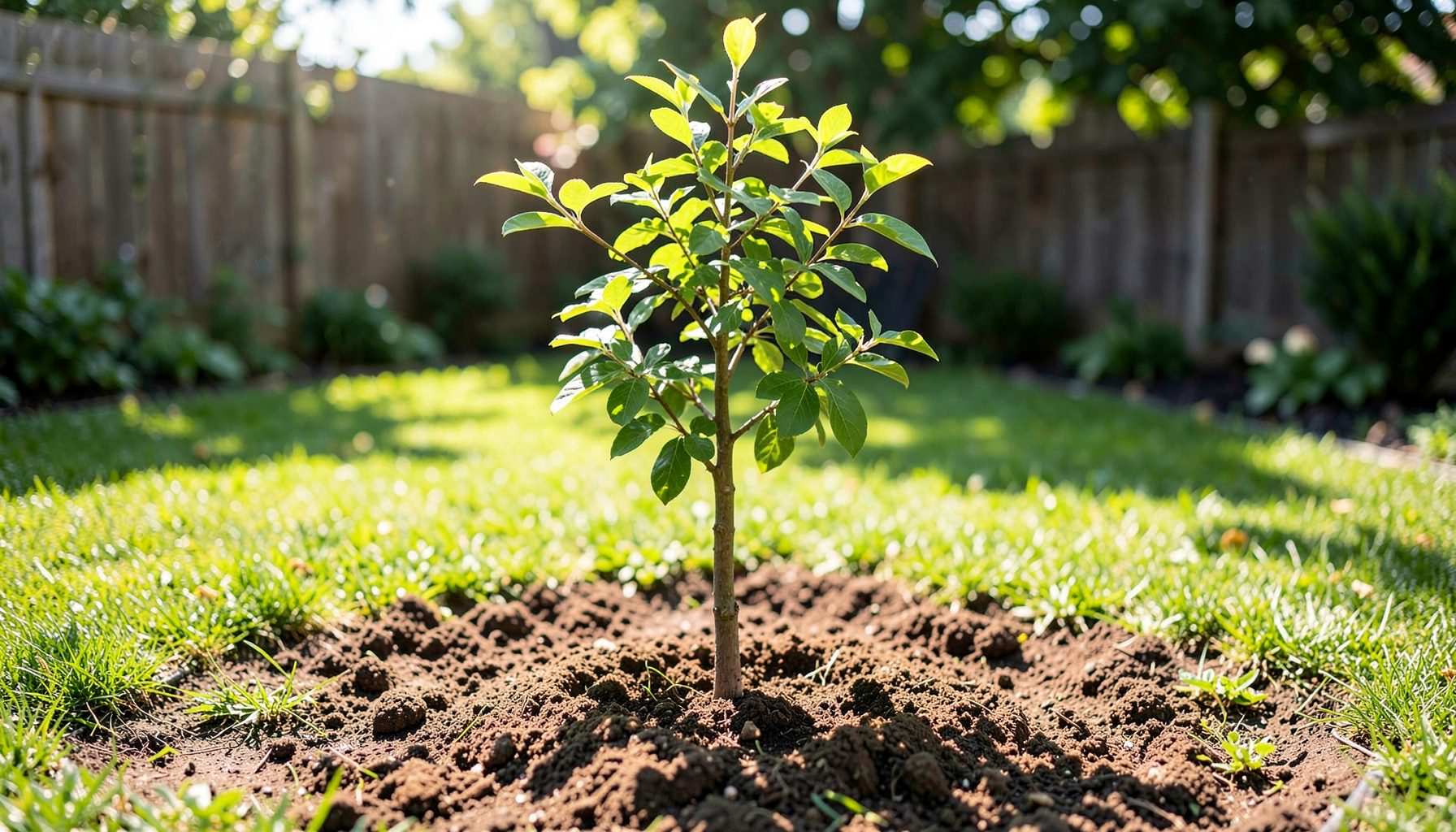
Place the root ball in the centre of the hole. The top of the root ball should sit level with, or slightly above, the surrounding ground because clay settles slowly and retains water. Find the trunk flare—the point where the trunk broadens into the main roots—and keep it visible. Never bury the flare under soil or mulch.
Backfill with the excavated soil, breaking up large clods by hand. Firm it gently to remove major air gaps, but do not compact the soil with your boots. Form a shallow basin just outside the root ball to guide water towards the roots, while leaving the trunk itself on slightly higher ground.
Water deeply and mulch carefully
Give the newly planted tree a slow, thorough soak immediately after planting. Water should reach the full root ball and surrounding loosened soil, not merely wet the surface. During the first growing season, check the soil several centimetres down before watering again. Clay may look dry on top while remaining wet below.
Frequency depends on season, rainfall, species and location. A sapling planted before a hot Perth summer may need close monitoring, while a winter-planted tree in Tasmania may need little supplementary water. In very hot weather, water early in the morning or later in the afternoon, following local restrictions and avoiding frequent shallow sprinkling.
Apply 50 to 75 millimetres of organic mulch over the root zone, extending it beyond the planting hole where possible. Keep a clear gap of at least 100 millimetres around the trunk. Mulch touching bark can trap moisture and encourage rot, pests or disease. For broader home upkeep habits, these ways to care for the property also support a consistent garden maintenance routine.
Support the sapling without restricting it
Most young trees do not need rigid staking in a sheltered garden. If the stem rocks heavily in wind, use one or two stakes positioned outside the root ball. Attach the trunk with a soft, wide tie that allows gentle movement. Movement helps the trunk develop strength, while a tight tie can cause rubbing and constriction.
Inspect the ties after several weeks and again after strong weather. Remove them when the tree can stand upright without help, commonly after one growing season. Replace broken stakes promptly if the site is exposed, but do not leave support materials around the trunk as a permanent fixture.
Protect the planting area from lawnmowers, pets and foot traffic. A simple temporary guard may prevent more damage than extra fertiliser. If the property has automated irrigation, check that spray reaches the tree without keeping the trunk constantly wet.
Watch for stress and drainage problems
Yellowing leaves, wilting despite damp soil, stunted growth and a sour smell near the roots can indicate waterlogging. Stop automatic watering and improve surface drainage first. Do not respond to every wilted leaf by adding water; roots in saturated clay may be unable to absorb oxygen even when moisture is abundant.
Dry, cracked soil and leaves that droop during the hottest part of the day can indicate water stress. Check below the mulch before watering and apply water slowly so it penetrates instead of running off. Avoid high-nitrogen fertiliser during establishment, as soft, rapid growth can place extra demand on a limited root system.
Keep an eye on the trunk, bark and foliage for chewing damage, borers or fungal symptoms. Home maintenance also includes related moisture checks: a faulty appliance can add unwanted dampness indoors, so use this guide to dryer troubleshooting when checking whether household water issues are contributing to broader problems.
A well-planted sapling may appear quiet for several months while roots establish beneath the surface. Continue checking soil moisture, mulch depth, ties and nearby competition from grass. The most useful next step is to choose the planting site, dig a drainage test hole and wait until the clay reaches a workable, crumbly condition before planting.